What the average human reaction time is, why browser tests read slower than a lab, how age changes the number, and what a genuinely fast score looks like.
Published September 2, 2026
Reaction time is the gap between a signal appearing and your body acting on it. On a reaction time test, that means the milliseconds between the screen changing state and your click landing. It sounds like a single number, but it is really three things stacked together: how fast your eyes and brain register the change, how fast you decide to move, and how fast the hardware between your finger and the browser reports it.
That last part is why the same person can score 210 ms on one setup and 280 ms on another without getting any slower.
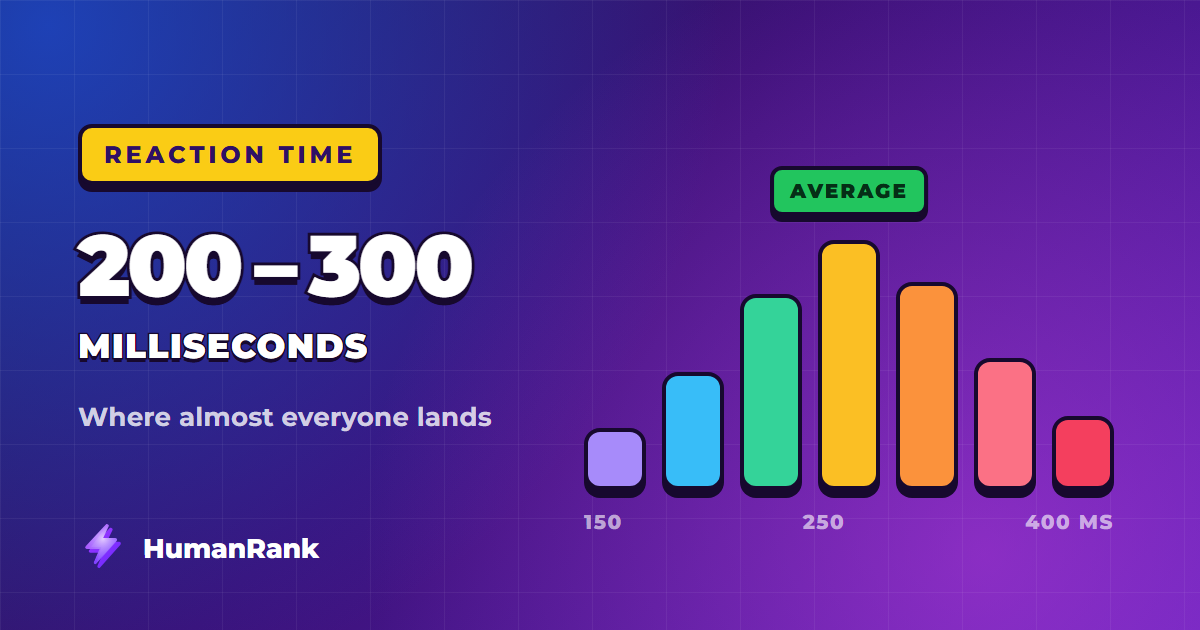
For a simple visual reaction task, meaning one signal and one response with no choice to make, healthy adults typically land somewhere between 200 and 300 milliseconds. Laboratory setups with dedicated hardware tend to sit at the fast end of that range, often near 200 ms. Browser-based tests, which include display and input delay, usually cluster closer to 250 to 300 ms.
Treat any single attempt as noise. A reaction time only becomes meaningful as an average across several clean attempts, because one lucky early click can flatter the whole run.
Find out where your own average lands.
Take the reaction time test
Your measured score includes every delay between the decision to show a signal and the moment the browser timestamps your click. Several of those delays have nothing to do with you:
Stacked together, these routinely add tens of milliseconds. That is why comparing your browser score to a published laboratory figure is misleading, and why comparing your own score across two different setups tells you more about the hardware than about you. Progress is only meaningful on one consistent setup.
A standard reaction test measures simple reaction time: one signal, one known response. Add options and the number climbs, because you now have to identify which signal appeared and select the matching action. This is choice reaction time, and it grows roughly with the logarithm of the number of options, the relationship known as Hick's law.
The distinction matters when you compare tests. An F1 start lights test keeps the response simple but adds an unpredictable delay, punishing anticipation instead of rewarding it. An aim trainer adds a movement component, so the score reflects motor control and pointer accuracy as much as raw reaction. Different numbers, different skills. They are not interchangeable.
One more well-established difference: auditory signals are processed faster than visual ones, typically by a few tens of milliseconds. If you have ever felt sharper reacting to a sound than to a light, that is real.
The overall shape is well documented and consistent across studies. Reaction time improves sharply through childhood, reaches its fastest point somewhere between the late teens and the mid twenties, holds a broad plateau through the thirties, then slows gradually. The decline is mild until around 60, and steeper after that.
The important caveat is that the spread within any age group is much larger than the difference between age groups. An attentive, well-rested 45-year-old on a low-latency setup will beat a distracted 20-year-old on a wireless mouse most days. Age shifts the average; it does not determine your score.
On a browser test, a clean average under 250 ms is genuinely fast, and under 220 ms puts you well ahead of most people testing on comparable hardware. But the more useful benchmark is your own previous average on the same setup. That comparison removes every hardware variable at once, and it is the only one that tells you whether anything actually changed.
On a simple visual reaction test, most adults land between 200 and 300 milliseconds. Laboratory measurements sit near the fast end of that range, while browser tests usually cluster between 250 and 300 ms because they also include display and input latency.
Yes. On a browser-based test, a clean average around 200 ms is very fast and puts you ahead of most people testing on comparable hardware. Anything consistently under 180 ms is rare enough to be worth checking for anticipation or an unusually low-latency setup.
A browser test measures your reaction plus the delay of the screen and the input device. Refresh rate, pixel response, mouse polling, and browser event handling routinely add tens of milliseconds that have nothing to do with your reflexes.
It follows a broad curve: fastest between the late teens and mid twenties, a long plateau through the thirties, then a gradual slowdown that becomes steeper after about 60. The spread within any age group is far larger than the gap between age groups, so age shifts the average without determining your score.
Some of it, yes. Sleep, attention, a proper warm-up, and a relaxed hand position all produce real gains, and practice on a specific task makes you faster at that task. The underlying biological limit moves very little, so most of the improvement comes from removing what was slowing you down.
A true reflex is an involuntary spinal response that bypasses the brain, like a knee jerk, and takes well under 100 ms. What a reaction test measures is voluntary: you perceive a signal, decide, and act. The word reflexes is used loosely for both, but only the second one is what you are scoring.