Reaction time by profession: who is actually the fastest?

Pro FPS players, F1 drivers, sprinters and fighter pilots all trade on reaction time. Here is what each job really demands, and why the numbers are not comparable.

Published September 3, 2026

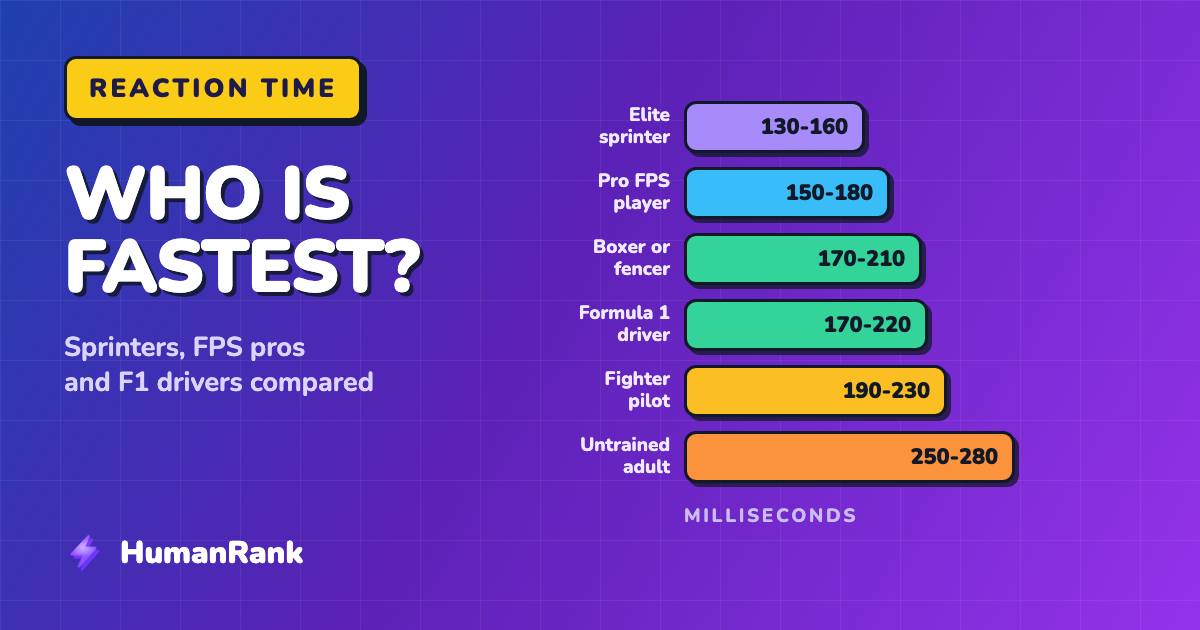
A bar chart comparing typical reaction time ranges for elite sprinters, pro FPS players, boxers, Formula 1 drivers, fighter pilots and untrained adults.

Some jobs pay for milliseconds, so it is tempting to line them up and ask who reacts fastest. The honest answer is that each one is measured on a different task, and the numbers do not transfer. What they share is worth borrowing, and you can see part of it on a reaction time test.

What the fastest professions actually score

The figures below are typical ranges reported for trained performers on their own task, not results from one shared test. Treat them as a map of what each job demands rather than a leaderboard.

Profession Range What is being measured
Elite sprinter 130-160 ms Reaction to a starting gun, which is a sound and therefore faster than a visual signal
Pro FPS player 150-180 ms Visual reaction plus aim, on very low-latency hardware, in a situation they have seen thousands of times
Boxer or fencer 170-210 ms Reading an opponent's movement, so anticipation carries much of the speed
Formula 1 driver 170-220 ms Reaction to the start lights going out, with a randomized delay that punishes guessing
Fighter pilot 190-230 ms Mostly choice reaction: identify the signal first, then select the right response
Untrained adult 250-280 ms A simple visual reaction test in a browser, including screen and input delay

Sprinters look fastest partly because of physics, not talent: auditory signals reach the brain faster than visual ones. World Athletics treats anything under 100 ms after the gun as a false start, because a genuine reaction that quick is considered impossible.

See how your own number compares to the ranges above.

Take the reaction time test

Why the pros are faster

  • Anticipation, not reflexes. A boxer who slips a punch is rarely reacting to the punch. They are reacting to the shoulder that moved first. Most of what looks like superhuman speed is a signal read earlier than everyone else reads it.
  • Pattern recognition. Thousands of hours narrow the number of things that can plausibly happen next, which shortens the decision step rather than the perception step.
  • Hardware. An esports pro plays on a high refresh rate monitor with a wired, high-polling mouse. That alone is worth tens of milliseconds compared to a laptop trackpad, before any skill is involved.
  • Preparation. Rested, warmed up, undistracted, and expecting the signal at a known moment. Every one of those is measurable, and most casual test-takers have none of them.

The part that does not move much is the raw biological floor. Signal transmission and muscle activation take what they take. Training buys you the steps around that floor, which is most of the number but not all of it.

What you can borrow from them

  1. Fix your setup before you chase a score. A wired mouse and a high refresh rate screen change your result more than a week of practice.
  2. Warm up. The first few attempts of any session are the slowest, and pros never compete cold.
  3. Practise the specific task. Reaction training transfers poorly between tasks, which is why an aim trainer improves aim rather than start-light reactions.
  4. Stop guessing. Anticipation produces a fast-looking number and a false start, and every serious test is designed to catch it.

If you want a fair sense of where you sit, run a clean average on one consistent setup rather than comparing a single attempt to a headline figure. Our guide on the average reaction time covers how to read that number honestly, and an aim trainer will tell you how much of your speed survives once movement is added.

Frequently asked questions

Which profession has the fastest reaction time?

Elite sprinters post the lowest numbers, around 130 to 160 ms, but they react to a starting gun, and sound is processed faster than sight. Among visual tasks, pro FPS players and Formula 1 drivers are the fastest, typically between 150 and 220 ms.

How fast do F1 drivers react to the start lights?

Roughly 170 to 220 ms from the lights going out to the clutch release, with the best starts at the fast end. The delay before the lights go out is randomized, so drivers cannot time it in advance without risking a jump start penalty.

Do pro gamers really have faster reactions than everyone else?

Partly. They are usually young, highly practised at one specific visual task, and playing on very low-latency hardware. Take away the hardware and the familiarity and the gap narrows considerably, though it does not disappear.

Can training make me as fast as a professional?

You can close most of the gap that comes from setup, attention, warm-up and task familiarity, which is the majority of it. The underlying biological limit barely moves, so nobody trains their way from 300 ms to 150 ms on the same test.
Games you might want to try

  • Reaction Time Measure how quickly you respond to a visual signal.
  • F1 Test React when the five start lights switch off.
  • Aim Trainer Improve target acquisition speed and pointer accuracy.
  • Home
  • Games
  • Tests
  • Leaderboards
  • Blog